
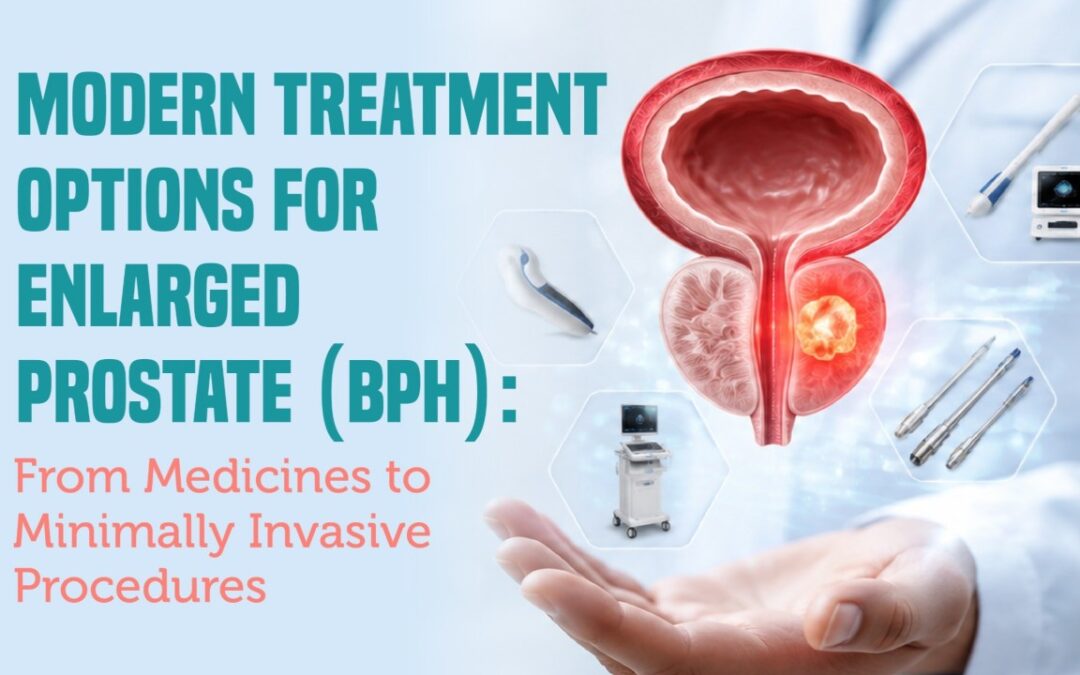
As men get older, changes in urinary habits can sometimes become part of everyday life. Waking up several times at night to urinate, having difficulty starting the urine stream, needing to rush to the bathroom or feeling that the bladder has not emptied completely may seem like things that simply come with age. But these symptoms should not always be ignored.
One of the most common causes of such urinary problems in older men is Benign Prostatic Hyperplasia (BPH), commonly known as an enlarged prostate. The good news is that modern urology offers several treatment options for BPH. Treatment is no longer limited to living with the symptoms or undergoing traditional surgery. Depending on the severity of symptoms, prostate size, urinary flow, overall health and individual preferences, treatment may include lifestyle changes, medicines, minimally invasive procedures or surgery.
So, what are the modern treatment options for an enlarged prostate, and how does a urologist decide which one is right for you? Let’s understand.
What Is an Enlarged Prostate?
The prostate is a small gland located below the bladder and surrounding part of the urethra—the tube through which urine leaves the body. As men age, the prostate may gradually increase in size. This non-cancerous growth is known as Benign Prostatic Hyperplasia, or BPH.
Importantly, BPH is not prostate cancer, and having an enlarged prostate does not mean that you have cancer. However, as the prostate grows, it can press against or narrow the urethra, making it more difficult for urine to pass. This can lead to what doctors call lower urinary tract symptoms (LUTS).
These may include:
- Difficulty starting urination
- A weak or slow urine stream
- Frequent urination
- A sudden or urgent need to urinate
- Waking up multiple times at night to urinate
- Dribbling after urination
- Feeling that the bladder has not emptied completely
- Difficulty stopping or controlling the urine stream
Not every man with an enlarged prostate needs treatment. If symptoms are mild and do not significantly affect daily life, a doctor may recommend monitoring and lifestyle changes. However, when symptoms begin affecting sleep, work, travel, social life or quality of life, it may be time to discuss treatment options with a urologist.
Does Every Enlarged Prostate Need Treatment?
No.
The size of the prostate alone does not determine whether treatment is necessary. Some men may have a significantly enlarged prostate but experience relatively few symptoms. Others may have a smaller prostate but experience considerable difficulty passing urine.
What matters is how the prostate is affecting urinary function and the person’s quality of life.
A urologist may consider factors such as the severity of symptoms, urinary flow, the amount of urine remaining in the bladder after urination, prostate size and shape, overall health and whether complications have developed. Treatment may be considered more strongly when symptoms are bothersome, medications are not providing adequate relief, or complications such as urinary retention or recurrent urinary infections develop.
How Is BPH Evaluated Before Treatment?
Before deciding on treatment, your urologist will usually want to understand both your symptoms and the condition of your urinary system. The evaluation may include a detailed medical history and discussion of your urinary symptoms.
Your doctor may also recommend tests such as a urine examination, PSA testing when appropriate, assessment of urinary flow, measurement of post-void residual urine, and evaluation of prostate size and shape using ultrasound or other investigations. In selected cases, cystoscopy or urodynamic testing may be required. This evaluation is important because urinary symptoms are not always caused by BPH. Conditions such as urinary tract infections, bladder problems, urethral narrowing or other prostate conditions can produce similar symptoms.
The goal is to identify the actual cause before choosing treatment.
Modern Treatment Options for Enlarged Prostate
1. Lifestyle Changes and Watchful Waiting
If BPH symptoms are mild, your urologist may recommend monitoring the condition rather than starting treatment immediately. This approach is sometimes referred to as watchful waiting or active monitoring.
It does not mean ignoring the condition. Instead, your symptoms and urinary health are monitored over time while you make practical changes that may help reduce discomfort.
Depending on your individual situation, these may include reducing fluids close to bedtime, limiting excessive caffeine and alcohol, staying physically active, avoiding prolonged holding of urine and making sure the bladder is emptied properly. For men with mild symptoms, these simple measures can sometimes make everyday urinary problems more manageable.
However, if symptoms are worsening, regular follow-up is important.
2. Medicines for BPH
When lifestyle changes are not enough, medicines may be recommended.
There are several types of medicines used to manage BPH symptoms.
Alpha-Blockers
Alpha-blockers work by relaxing the muscles around the prostate and bladder neck. This can make it easier for urine to pass and may improve urinary symptoms. They are commonly used to provide relatively quick relief from symptoms.
However, medicines can have side effects, and the appropriate medication depends on the individual’s health and other medicines they may be taking.
5-Alpha Reductase Inhibitors
These medicines work differently.
They can help reduce the growth of the prostate and, in some men, gradually shrink the prostate. They may be particularly useful when the prostate is significantly enlarged.
Unlike alpha-blockers, their effect may take longer to become noticeable.
In some situations, doctors may use an alpha-blocker and a 5-alpha reductase inhibitor together. Research indicates that combination treatment can be more effective than either medicine alone for certain men.
Tadalafil
Tadalafil, a phosphodiesterase-5 inhibitor, may also be prescribed for some men with BPH-related urinary symptoms.
It can relax smooth muscle around the bladder and prostate and may improve certain urinary symptoms. It may be particularly relevant for men who also have erectile dysfunction. However, it is not suitable for everyone and should only be used after discussing your medical history and other medications with your doctor.
3. Minimally Invasive Treatment Options
One of the significant developments in modern BPH treatment is the availability of minimally invasive procedures.
These treatments aim to improve urine flow by reducing or bypassing the obstruction caused by an enlarged prostate, often with less tissue removal than traditional surgery.
Depending on the patient’s prostate anatomy and clinical situation, options may include procedures such as prostatic urethral lift (UroLift) and water-vapor thermal therapy (Rezum). Other minimally invasive approaches are also available in selected patients.
UroLift
The prostatic urethral lift, commonly known by the brand name UroLift, uses small implants to hold enlarged prostate tissue away from the urethra. The aim is to create more space for urine to flow through.
Because the procedure does not involve removing prostate tissue in the same way as conventional resection, it may be an option for appropriately selected patients who are looking for a minimally invasive approach. However, UroLift is not suitable for every prostate. Prostate size, anatomy and the presence of features such as a median lobe can influence whether it is appropriate.
Rezum Water Vapor Therapy
Rezum is a form of water-vapor thermal therapy.
In this procedure, controlled doses of steam are delivered into targeted areas of enlarged prostate tissue. The treatment causes the targeted tissue to shrink over time, helping relieve obstruction and improve urinary symptoms. Like other minimally invasive treatments, it is not appropriate for every patient.
A urologist needs to assess the prostate’s size and anatomy, the severity of symptoms and other individual factors before recommending it.
4. Laser Treatment for Enlarged Prostate
Laser technology has become an important part of modern prostate treatment. Laser procedures can be used to remove or vaporise obstructing prostate tissue and improve the flow of urine. One commonly used approach is Holmium Laser Enucleation of the Prostate (HoLEP).
In HoLEP, the surgeon uses a laser to separate and remove the obstructing portion of the prostate while preserving the surrounding structures as much as possible.
Laser-based procedures may be particularly useful for certain patients, including men with larger prostates, although the most appropriate technique depends on the individual’s anatomy and the surgeon’s assessment.
The key advantage of modern laser techniques is that they allow surgeons to treat prostate obstruction through the urinary passage rather than making a large external incision.
5. TURP – A Well-Established Surgical Option
While newer techniques have expanded the treatment choices available today, Transurethral Resection of the Prostate (TURP) remains an established treatment for BPH. During TURP, the surgeon passes an instrument through the urethra and removes portions of the prostate tissue that are obstructing urine flow.
Because the procedure is performed through the urinary passage, there is no large external incision. TURP has been used for many years and can provide significant improvement in urinary symptoms for appropriately selected patients.
However, modern treatment decisions are increasingly individualised. Depending on prostate size, anatomy, symptoms, medical history and patient preferences, a urologist may discuss TURP alongside laser or minimally invasive alternatives.
6. Other Surgical Options for Larger Prostates
Some men have very large prostates or complicated BPH that may require a more extensive procedure. Depending on the situation, options can include laser enucleation, simple prostatectomy or other surgical approaches.
The appropriate procedure depends on factors such as prostate size, anatomy, urinary obstruction, previous treatments and the patient’s overall health. The important point is that there is no single “best BPH treatment” for every patient.
The best treatment is the one that appropriately addresses the individual’s condition while considering their medical needs and personal priorities.
When Should You Consider a Procedure Instead of Medicines?
Not every man with BPH needs surgery or a minimally invasive procedure.
However, a procedure may be considered when symptoms remain bothersome despite medication, when medication is not suitable or tolerated, or when BPH leads to complications. Doctors may consider procedural treatment when there is significant urinary obstruction, recurrent urinary retention, recurrent urinary tract infections, visible blood in the urine related to BPH, bladder problems or symptoms that continue to significantly affect quality of life despite medical treatment.
If you are waking up several times every night, planning your day around the availability of toilets, avoiding travel because of urinary urgency or struggling to pass urine, it may be worth discussing your options with a urologist.
Does BPH Treatment Affect Sexual Function?
This is one of the most common concerns men have when considering prostate treatment. The answer depends on the treatment.
Different medicines and procedures can have different effects on sexual function and ejaculation. Some BPH medicines can affect ejaculation or sexual function in certain men, while surgical procedures can also have sexual side effects.
For example, some prostate procedures can cause retrograde ejaculation, where semen enters the bladder instead of exiting through the penis during ejaculation. This does not necessarily mean that sexual pleasure or erection will be lost, but it can affect fertility and ejaculation.
Because sexual health is an important part of quality of life, men should discuss these concerns openly with their urologist before choosing a treatment. The goal is not simply to improve urine flow—it is to choose a treatment that fits the patient’s overall health and priorities.
Is BPH the Same as Prostate Cancer?
No.
Benign Prostatic Hyperplasia is not prostate cancer.
BPH refers to non-cancerous enlargement of the prostate. However, BPH and prostate cancer can occur in the same person, and urinary symptoms alone cannot reliably distinguish between different prostate conditions.
This is why men with new or persistent urinary symptoms should not simply assume that the problem is “just an enlarged prostate.” A urologist can evaluate the symptoms and determine whether further testing is appropriate.
Why You Shouldn’t Ignore BPH Symptoms
Many men live with urinary symptoms for years because they assume they are a normal part of ageing. But constantly waking up at night to urinate can affect sleep.
A weak urine stream can make everyday activities frustrating. Difficulty emptying the bladder can increase the risk of urinary retention.
And in some cases, untreated or inadequately managed bladder outlet obstruction can contribute to complications such as recurrent urinary infections or bladder problems. You do not necessarily have to live with these symptoms simply because you are getting older.
Modern urology offers multiple treatment approaches, and an evaluation can help determine whether you need monitoring, medication or a procedure.
Choosing the Right BPH Treatment
The most important thing to remember is that BPH treatment is not one-size-fits-all.
A treatment that works well for one man may not be appropriate for another.
Your urologist may consider:
- Your age and overall health
- Severity of urinary symptoms
- Prostate size and anatomy
- Urinary flow
- Amount of urine left in the bladder after urination
- Previous treatments
- Other medical conditions
- Medications you currently take
- Your priorities regarding recovery and sexual function
- Whether complications have developed
Only after considering these factors can the most appropriate treatment be recommended.
Don’t Let an Enlarged Prostate Control Your Routine
An enlarged prostate may be common, but struggling to urinate, constantly searching for a bathroom or waking multiple times every night does not have to become something you simply accept. From lifestyle changes and medicines to minimally invasive BPH procedures, laser treatments and established surgical techniques, modern urology provides several ways to manage an enlarged prostate.
The first step is knowing what is causing your symptoms and understanding your treatment options. If you are experiencing difficulty urinating, frequent nighttime urination, a weak urine stream, urgency or incomplete bladder emptying, speak with a urologist.
At Ace Hospital, Pune, the Urology Department provides evaluation and treatment for prostate and urinary conditions. A specialist can assess your symptoms, evaluate your prostate and help determine the treatment approach most appropriate for your condition.
Better urinary health starts with understanding your options.
Don’t ignore persistent urinary symptoms. Consult a urologist at Ace Hospital, Pune.
Frequently Asked Questions About Enlarged Prostate Treatment
Can an enlarged prostate be treated without surgery?
Yes. Depending on the severity of symptoms, BPH can sometimes be managed with lifestyle changes and medicines. Minimally invasive procedures may also be considered when appropriate.
What is the latest treatment for an enlarged prostate?
There is no single “latest” treatment that is best for everyone. Modern options include medicines, minimally invasive procedures such as UroLift and Rezum, laser procedures such as HoLEP, TURP and other surgical approaches. The appropriate treatment depends on prostate size, anatomy, symptoms and the patient’s overall health.
Is laser treatment better than TURP?
Laser procedures and TURP can both effectively treat urinary obstruction caused by BPH. Whether one is more suitable than the other depends on factors such as prostate size, anatomy, medical history and the surgeon’s expertise. A urologist can explain the advantages and limitations of each option for an individual patient.
Is UroLift suitable for every patient?
No. UroLift is appropriate only for selected patients. Prostate anatomy, size and other factors need to be evaluated before deciding whether it is a suitable option.
Does an enlarged prostate always require surgery?
No. Many men with mild or moderate symptoms can be managed with monitoring, lifestyle changes or medicines. Surgery or a minimally invasive procedure may be considered when symptoms are severe, medications are ineffective or complications develop.
Can BPH come back after treatment?
BPH treatment can provide long-term relief, but symptoms can sometimes return and some patients may require further treatment in the future. The likelihood depends on the treatment used and individual factors.
When should I see a urologist for an enlarged prostate?
Consider seeing a urologist if you have persistent difficulty starting urination, a weak urine stream, frequent nighttime urination, urinary urgency, incomplete bladder emptying, recurrent urinary infections or episodes of urinary retention.
Medical Disclaimer: This article is intended for general health education and does not replace professional medical diagnosis, consultation or treatment. Treatment for BPH should be determined by a qualified urologist after evaluating the patient’s symptoms, prostate condition, medical history and individual needs.