
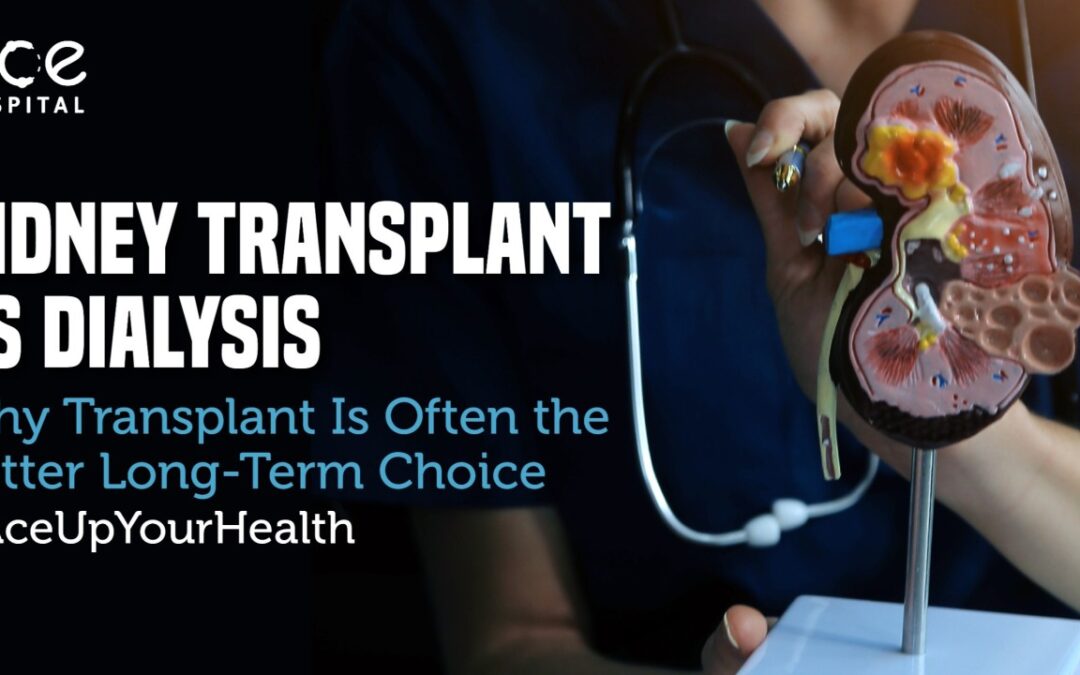
When kidneys fail, life changes from the inside out. Toxins and fluid build up, blood pressure swings, bones weaken, energy fades — and every day begins to orbit around treatment. Modern medicine offers two proven ways to replace kidney function: dialysis (a machine-based substitute) and kidney transplantation (restoring natural function with a donated kidney). Both save lives. But for most eligible people, transplantation consistently delivers better survival, better quality of life, and lower long-term costs than remaining on dialysis — conclusions echoed in international clinical guidelines and large registry studies. Lippincott JournalsAJKDAmerican Journal of Transplantation
This article explains your kidneys in plain language, unpacks how dialysis and transplant actually work, and then expands into India-specific barriers, key innovations, what life looks like after a transplant, and a balanced conclusion to help patients and families make informed choices.
Chapter 1: Understanding Kidney Function — Why Failure Changes Everything
Your kidneys (two fist-sized organs tucked under the rib cage) are sophisticated chemical plants. Every minute, they filter your blood, clearing wastes (urea, creatinine), balancing water and electrolytes (sodium, potassium), fine-tuning blood pressure, stimulating red-blood-cell production (through erythropoietin), and maintaining acid-base balance. When this harmony breaks down in chronic kidney disease (CKD) or end-stage kidney disease (ESKD), you can’t simply “drink more water” to fix it — because the organ’s integrated regulatory system has failed.
What patients feel at this stage varies: swelling of legs and face, breathlessness (fluid overload), muscle cramps, bone pain, nausea, metallic taste, skin itching, anemia-related fatigue, and sometimes confusion. Lab tests reveal rising creatinine and urea, abnormal potassium, acidemia, and falling hemoglobin. Treatment urgency depends on symptoms, complications (e.g., high potassium), and the rate of decline.
Two main renal replacement therapies step in when kidneys can’t keep up:
- Dialysis: a mechanical or peritoneal “filter” that removes wastes and fluid.
- Transplantation: replacing the failed function with a living or deceased donor kidney.
International guidance emphasizes that patients approaching kidney failure should be fully informed about all options — including transplantation — early enough to plan safely. PubMed
Chapter 2: Dialysis — The Life-Support Bridge
Dialysis is indispensable. It saves lives daily, stabilizing patients until a transplant is possible — or sustaining those for whom transplant isn’t appropriate. There are two main forms:
Hemodialysis (HD)
Blood flows from your body to a dialysis machine through a vascular access (fistula, graft, or catheter), passes across a semipermeable membrane where wastes and excess fluid are drawn off, and returns clean. Most in-center schedules are three sessions per week, ~4 hours each (protocols vary by country and patient). Side effects can include fatigue after sessions, low blood pressure, cramps, headaches, and access infections or clotting over time. Health
Peritoneal Dialysis (PD)
Your peritoneum (the inner lining of the abdomen) acts as the filter. Dialysate fluid flows into the belly via a soft catheter, dwells to absorb wastes, then drains. This can be done by hand several times a day (CAPD) or overnight with a small bedside machine (APD). PD offers independence and travel flexibility, but requires strict hygiene to prevent peritonitis.
The Upside and the Limits
Why dialysis is invaluable: It’s available immediately in most cities; it can be initiated urgently; PD can be done at home; and it buys time — sometimes years — while patients optimize health or await a donor.
Where dialysis strains life: It’s time-intensive; diet and fluid intake are closely restricted; vascular or peritoneal access can complicate; and many people experience “roller-coaster” energy with post-dialysis fatigue. Over years, outcomes lag behind transplantation for most eligible patients, in both survival and quality-of-life measures. Lippincott JournalsAmerican Journal of Transplantation
Chapter 3: Kidney Transplant — Restoring Natural Function
A kidney transplant places a healthy donor kidney (living or deceased) into your lower abdomen, connecting it to your vessels and bladder. In many cases the new kidney “wakes up” quickly; in others, it may need a few days. You keep your native kidneys unless there’s a specific reason to remove them.
Why transplant is often preferred
Across multiple countries and registries, transplantation improves survival and quality of life compared with remaining on dialysis. Patients typically regain appetite and energy, enjoy fewer fluid and dietary restrictions, return to work or study more easily, and experience better cardiovascular outcomes long term. Health-economic analyses and clinical guidelines also note that, although transplantation has upfront costs, it is often less costly over time than years of ongoing dialysis. Lippincott JournalsAmerican Journal of TransplantationJAMA Network
Nuance matters: the very elderly or those with severe comorbidities may see a smaller or delayed survival advantage; decisions must be individualized with your transplant team. PubMed
The trade-offs you should know
- Finding a donor is the main bottleneck (see India-specific barriers below).
- Surgery risks: bleeding, infection, thrombosis; these are uncommon but real.
- Rejection: the immune system may attack the graft; modern immunosuppression greatly reduces this risk but requires lifelong anti-rejection medication and monitoring.
- Infections & screening: because immunity is dampened, you’ll follow tailored vaccination and prevention plans.
Barriers in India — What Stands Between Patients and Transplant
India performs a large absolute number of transplants (third in the world by volume), yet deceased organ donation remains very low relative to need. Recent reports put India’s deceased donor rate at below 1 donor per million population, though some states (e.g., Telangana) have reached higher rates, showing what’s possible with coordinated systems. Capacity is improving, but demand far outstrips supply. The New Indian ExpressPMC
Key obstacles:
- Donor shortage & uneven systems Low deceased donation rates, variable declaration of brain death, and uneven retrieval networks limit organ availability, despite record overall transplant numbers. DD NewsThe Times of India
- Awareness & myths Misconceptions about organ donation persist. National and state campaigns — including pledges via NOTTO — are expanding awareness, but conversion from pledges to actual deceased donation remains the challenge. Press Information BureauNotto
- Infrastructure & workforce Shortages of trained retrieval teams and transplant surgeons, plus gaps in ICU and coordination capacity in many districts, create delays or missed opportunities. The Times of India
- Wait-list and affordability dynamics Even with growing living donation, many patients remain on dialysis for years while waiting — a period associated with higher mortality and lower post-transplant outcomes compared with preemptive or early transplant. (This is one reason clinicians push for early referral and evaluation.) PubMed
Bright spots:
- Kidney-paired donation programs (swap transplants) help incompatible living donor pairs exchange kidneys through chains, reducing wait times; Gujarat has been a national leader. The Times of India
- A growing national network and annual records in overall transplants suggest momentum — but sustained investment and public education are essential. DD News
Innovations Changing Kidney Transplantation
- Robotic-Assisted Kidney Transplant (RAKT) In select centers, robotic surgery can reduce incision size, lower blood loss, reduce pain, and cut surgical-site infections — benefits highlighted particularly in obese patients — with similar medium-term graft outcomes to open surgery. Availability varies by center and surgeon expertise. Lippincott JournalsPMCBioMed Central
- ABO-Incompatible (ABOi) Transplant When a willing living donor’s blood group doesn’t match the recipient, modern desensitization protocols (plasmapheresis, immunomodulation) make transplantation feasible, with encouraging short- and longer-term outcomes in many series and meta-analyses. This option is complex and not right for everyone, but it expands access where deceased donation is scarce. PubMedPMC
- Kidney-Paired Donation (KPD) & Exchange Chains National and regional KPD networks match incompatible pairs to others to enable compatible exchanges, sometimes involving multiple pairs in one cycle — an important lever in India to offset low deceased donation. The Times of India
- Normothermic Machine Perfusion (NMP) Emerging preservation technology that keeps kidneys warm and metabolically active outside the body may help assess or improve organs from marginal donors. Results are promising but mixed; some randomized trials show limited benefit on early outcomes so far, and protocols aren’t standardized yet. Still, it’s a fast-moving field with ongoing trials and early feasibility studies showing safety. PMCLippincott JournalsAJKD
- Next-gen Immunosuppression (e.g., Belatacept pathways) Research continues on regimens that preserve graft function while minimizing toxicity (blood pressure, diabetes, kidney injury). Belatacept-based strategies can improve renal function and some cardiovascular risk markers compared with calcineurin inhibitors in certain settings, though not all studies agree on long-term mortality and graft failure risks; decisions are individualized. Frontierskidneymedicinejournal.orgCleveland Clinic Journal of Medicine
Life After a Kidney Transplant — What Day-to-Day Really Looks Like
The first weeks: you’ll have frequent check-ups for labs and medication adjustments. Energy returns gradually; walking daily is encouraged, with most people adding moderate exercise by ~6–8 weeks, if recovery is smooth. Heavy contact sports are discouraged because a transplanted kidney sits relatively superficially in the lower abdomen. nhsbt.nhs.uk+1
Medications: you’ll take immunosuppressants (commonly combinations around tacrolimus, mycophenolate, and steroids, with center-specific variations). Taking them exactly as prescribed prevents rejection. Your team will also tailor infection prevention and vaccine plans (e.g., inactivated vaccines on schedule; live vaccines generally avoided post-transplant unless directed by specialists). KDIGO
Diet & hydration: Compared with dialysis, your diet is far more flexible — but heart-healthy, lower-salt, high-fibre patterns are encouraged. Food-safety matters because of immunosuppression (avoid unpasteurized dairy; wash produce well). Stay hydrated; your team will set targets based on kidney function, heart status, and medications. National Kidney FoundationImperial College Healthcare NHS TrustCambridge University Hospitals
Work, travel, and family life: Many people return to work or study once stamina improves. Travel is possible with planning (medication supply, clinic contacts). For family planning, pregnancy can be considered after careful discussion — typically after at least a year of stable graft function and medications compatible with pregnancy (your team will individualize). Resources from national kidney organizations provide checklists and recovery timelines you can follow with your clinic. National Kidney Foundation
Bottom line: after the early healing window, most transplant recipients describe life as more normal and active than on dialysis — precisely why transplant is prioritized for eligible patients. Lippincott Journals
Final Conclusion — How to Decide What’s Right for You
- Dialysis keeps you safe when kidneys fail, and it’s the essential bridge while you’re being evaluated or waiting for a donor.
- Transplantation, when feasible, offers better survival, better quality of life, and is often more cost-effective over time than remaining on dialysis. That’s why global guidelines frame transplant as the preferred therapy for most eligible people. Lippincott JournalsAJKD
For patients in India, the biggest challenge isn’t whether transplant works — it’s timely access: donor scarcity, uneven infrastructure, and long waits. The good news is that paired exchanges, ABO-incompatible protocols, and robotic approaches are expanding options and improving experiences, while national efforts aim to raise donation rates. The Times of IndiaPubMedLippincott Journals
What you can do next
- Ask for an early transplant evaluation — even before dialysis starts, if possible. Preemptive or early transplantation is linked to better outcomes. PubMed
- Discuss donor options with your team (living related/unrelated, KPD chains, ABO-incompatible pathways). PubMed
- Stay “transplant-ready”: keep vaccinations current, optimize diabetes and blood pressure, and follow nutrition and exercise guidance from your clinicians. KDIGONational Kidney Foundation
- If you’re a supporter: learn about organ donation and consider pledging with NOTTO; public awareness and consent save lives. Press Information Bureau
Medical disclaimer: This article is educational and does not replace personalized medical advice. Decisions about dialysis and transplantation must be made with your nephrologist and transplant team after considering your health, age, comorbidities, and support system.