
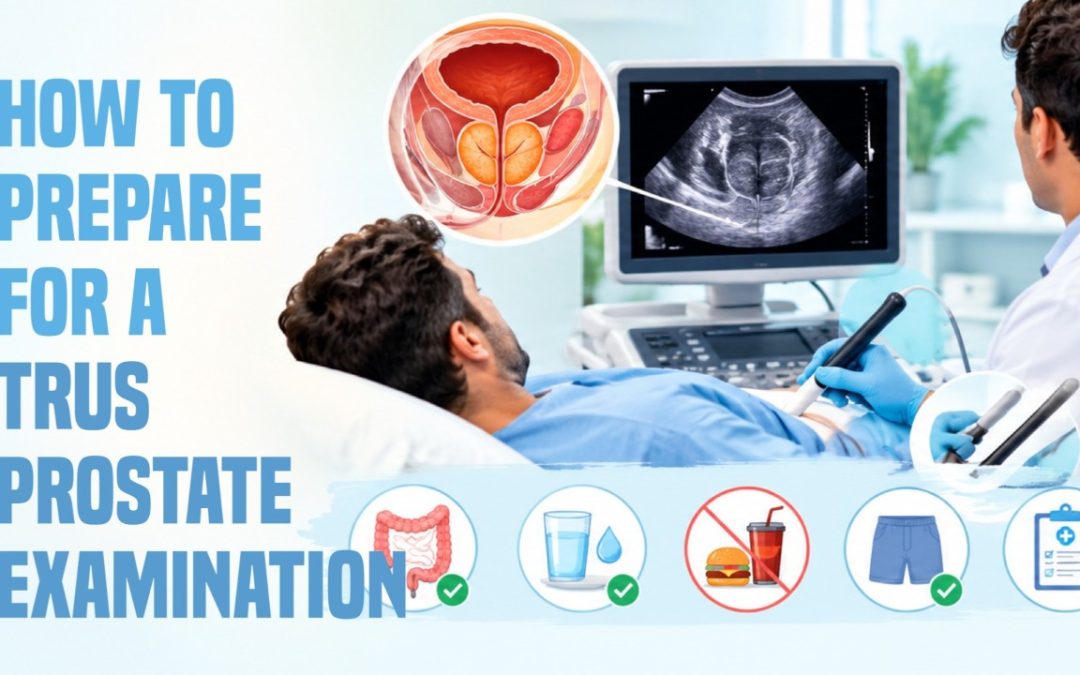
Being told you need a prostate scan can bring a wave of questions. What will happen? Will it hurt? Do I need to do anything beforehand? For most men, the uncertainty is far more stressful than the test itself.
The truth is reassuring. A TRUS (Transrectal Ultrasound) examination of the prostate is a quick, safe and routine procedure. With a little preparation, it goes smoothly and is over in minutes. This guide explains exactly how to prepare, so you can walk in informed and at ease.
A Quick Recap: What Is TRUS?
TRUS uses sound waves to create detailed images of the prostate gland. A slim, lubricated probe, about the width of a finger, is gently placed in the rectum, which sits right next to the prostate. The scan helps the urologist measure prostate size, look for abnormal areas, investigate a raised PSA, and, when needed, guide a biopsy.
Preparation differs slightly depending on whether you are having a scan only or a scan with a biopsy. Your doctor will tell you which one is planned.
Before the Day of Your Test
1. Share Your Complete Medical History
Tell your urologist about:
• Any medicines you take, especially blood thinners such as aspirin, clopidogrel, warfarin or newer anticoagulants
• Allergies, particularly to antibiotics, latex or anaesthetic medicines
• Diabetes, heart conditions, artificial heart valves or joint replacements
• Recent urinary infections, fever or burning while passing urine
• Piles (haemorrhoids), anal fissures or previous rectal surgery
2. Ask About Your Medicines
For a scan alone, most medicines can be continued as usual. If a biopsy is planned, your doctor may ask you to pause blood thinners for a few days. Never stop any medicine on your own. Some blood thinners must not be stopped without advice from the doctor who prescribed them.
3. Bring Your Reports
Carry recent PSA reports, urine test results, previous ultrasound or MRI scans, and your prescription list. These help the specialist interpret the findings accurately.
On the Day of the Test
• Bowel preparation: you may be asked to use a mild enema a few hours before the test to clear the lower bowel. This gives clearer images and makes the procedure more comfortable.
• Eating and drinking: for a scan alone, you can usually eat and drink normally. Follow any specific instructions your hospital gives you.
• Bladder: some centres prefer a moderately full bladder. Ask in advance.
• Clothing: wear loose, comfortable clothes. You will change into a hospital gown.
Extra Steps if a Biopsy Is Planned
A TRUS-guided biopsy needs a little more preparation:
• Antibiotics: you will usually be given antibiotics before and sometimes after the procedure to reduce the risk of infection. Take them exactly as prescribed.
• Blood tests: a urine test, and occasionally a clotting test, may be done beforehand.
• Company: bring a family member or friend to accompany you home.
• Rest: plan a quiet day afterwards and avoid heavy lifting or strenuous exercise for a day or two.